
Turning 65? Your 7-month Medicare window starts ticking before your birthday
Part 1 of 9: The Next Chapter: A Senior's Guide to the Years Ahead
In brief: Turning 65 triggers a 7-month Medicare enrollment window. Miss it without qualifying coverage and you'll pay a Part B penalty of 10% for every 12 months delayed; for life. COBRA and retiree health plans don't count as creditable coverage. If your spouse has employer coverage from a company with 20+ employees, you may be able to delay without penalty.
You probably remember turning 16. Maybe 21. And if you're reading this, your 65th birthday is either on the way or maybe a few candles ago.
Here's the thing nobody really tells you about turning 65: a clock starts ticking about three months before the candles even come out.
That clock is your Medicare Initial Enrollment Period, and it's a seven-month window to sign up. It starts three months before the month you turn 65, includes your birthday month, and ends three months after. If you miss it, the bill can follow you around for a long time.
Meet Linda
Linda is 64 and lives in Phoenix. She works part-time as a bookkeeper, and she's married to Matt, who's 61 and still works full-time at a marketing firm with about 80 employees. Linda gets her health insurance through Matt's plan, and she turns 65 in April.

Img 1.1: Most people in Linda's situation don't realize the answer depends on details most HR departments don't volunteer.
Her question is the one most people have when they get to this point: do I need to sign up for Medicare right now, or can I wait? The answer depends on a few specifics and Linda's situation is more common than you might think.
If your spouse is still working
Because Matt's employer has more than 20 employees, Linda can stay on his plan and delay Part B without being penalized for it. When Matt eventually retires or loses coverage, she'll get an eight-month Special Enrollment Period to sign up for Medicare with no late fees. The full Special Enrollment Period rules are on the Social Security Administration site.
But if Matt worked at a smaller company, say fewer than 20 employees, the rules flip. Medicare would become Linda's primary insurance the moment she turns 65, and she'd need to enroll during her window or end up paying penalties.
So let's talk about two traps a lot of people fall into.
The first one involves something called COBRA. When someone leaves a job, whether by quitting, retiring, or getting laid off, federal law lets them keep their employer's health insurance for up to 18 months, as long as they pay the full premium themselves. It's a bridge most people use to avoid a gap in coverage between jobs, or to ease into retirement without having to scramble for a new plan overnight. On paper, it feels like the same insurance you had at work.
But here's where it gets tricky: COBRA doesn't count as creditable coverage for Medicare. Say Matt retires at 64 and Linda stays on his COBRA for the next 18 months until it runs out. She might assume she's been covered the whole time, so why would Medicare penalize her? The problem is that the Medicare clock started the day Matt walked out of the office, not the day COBRA ended. By the time she finally signs up, she could be a year and a half late, with penalties attached to her premium for the rest of her life.
Retiree health plans work the same way. Some employers offer health coverage to retirees as a benefit, and it can actually feel more secure than COBRA because it's not time-limited. But Medicare treats it the same way: it's nice to have, but it doesn't get you off the hook for enrolling on time. We can help.
The safest move is to ask your spouse's HR department one specific question: "Does this plan qualify as creditable coverage for Medicare?" And get the answer in writing.
Everything you need to know before you turn 65
Our complete guide walks you through Medicare enrollment, coverage choices, and the decisions that affect the next 20 years.
The cost of being late
If you skip your window without qualifying coverage, the federal government adds a penalty to your premium.
Forever.
Details on the penalty structure are laid out by Medicare directly.
For Part B, the penalty is 10% for every 12 months you delayed, and you pay it for as long as you have Part B. The standard Part B premium in 2026 is $202.90 a month. If you wait two years, you're paying about 20% extra, or roughly $40 more a month, for the rest of your life. Spread that over 20 years of retirement, and you've handed close to $10,000 to the government just for being late. This is the kind of avoidable cost a proper retirement income plan is designed to catch before it happens.
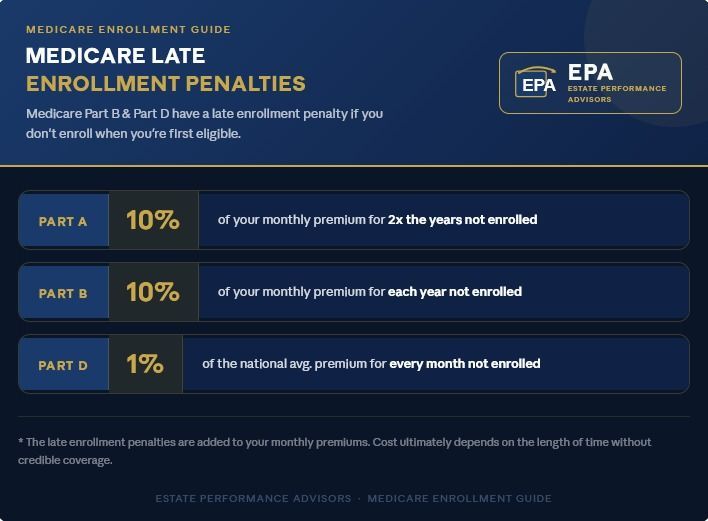
Img 1.2: Late enrollment penalties get added to your monthly premium and stick around for as long as you have coverage. Spread over 20 years of retirement, the math gets ugly fast.
For Part D, which covers prescription drugs, the penalty is 1% per month delayed, added to your drug plan premium permanently. It doesn't sound like much month to month, but it adds up over a long retirement.
The point is, these aren't one-time fees you can pay off and move on. They stay with you.
The money-saver almost nobody mentions
Some Medicare Advantage plans offer something called the Part B "giveback," where the plan pays part or all of your Part B premium back to you. In 2026, that benefit can range from a few dollars a month all the way up to the full $202.90. The savings show up as a smaller deduction from your Social Security check, which means more money in your pocket every month.

Img 1.3: For the right ZIP code and the right plan, the giveback can put an extra $50 to $100 back in your monthly check.
There's a catch, of course. Not every plan offers it, and availability really depends on your ZIP code. Plans in competitive markets like Florida or parts of California tend to offer the biggest givebacks, while smaller markets might offer little or nothing. Around 30% of plans with a giveback offer $10 or less per month.
There's another thing to watch for too. A giveback plan might lower your premium but raise your copays, narrow your network of doctors, or drop a specialist you've been seeing for years. So don't pick a plan based on the giveback alone. But if everything else lines up, an extra $50 or $100 a month back in your check is worth knowing about.
The bottom line
Most people don't have someone walking them through this. They get a Medicare card in the mail, panic a little, sign up for whatever seems easiest, and then find out years later that they overpaid or missed something important.
Your seven-month window isn't just a deadline. It's the moment to start asking the right questions, about your spouse's plan, about whether your current coverage actually counts, about which Medicare path fits the life you're stepping into. Getting those answers before the clock runs out is exactly the kind of thing a good advisor helps you think through in an hour.
Once you've sorted out Medicare, there's a much bigger surprise waiting for most people. If you ever need help bathing, dressing, getting around the house, or just managing daily life as you get older, Medicare won't pay for it. That kind of care, called custodial or long-term care, can run anywhere from $4,500 to $13,000 a month, and it's where most of the real out-of-pocket risk in retirement actually lives.
The good news is that there are ways to plan for it; long-term care insurance, hybrid life insurance policies, annuities designed to cover care costs, but the time to look at them is well before the need shows up. We'll get into what that planning actually looks like next week.
Frequently Asked Questions About Medicare Enrollment at 65
When does Medicare enrollment start?
Your Medicare Initial Enrollment Period starts three months before the month you turn 65, includes your birthday month, and ends three months after; a seven-month window total.
What happens if I miss my Medicare enrollment window?
You'll pay a penalty added to your Medicare Part B premium for as long as you have Part B — 10% extra for every full 12 months you delayed. Part D drug coverage has its own permanent penalty of 1% per month delayed.
Can I delay Medicare if I'm still working at 65?
If your employer has 20 or more employees and offers creditable coverage, yes. You can delay Part B without penalty and use an eight-month Special Enrollment Period later. If the employer has fewer than 20 employees, Medicare becomes your primary insurance at 65.
Does COBRA count as creditable coverage for Medicare?
No. COBRA is not considered creditable coverage. If you delay Medicare enrollment while on COBRA, the late enrollment penalty starts the day your employer coverage ended, not the day COBRA runs out.
What is the Medicare Part B premium in 2026?
The standard Part B premium in 2026 is $202.90 a month. Higher earners pay more based on income.
What is the Medicare Advantage giveback benefit?
Some Medicare Advantage plans offer a giveback that reimburses part or all of your Part B premium, which shows up as a smaller deduction from your Social Security check. Availability varies significantly by ZIP code.
How long is the Medicare Special Enrollment Period?
If you delayed Part B because you had creditable employer coverage, you get an eight-month Special Enrollment Period after that coverage ends to sign up without a penalty.
Next: Part 2 — Long-term care and custodial care: The Medicare gap that can cost $7,000 a month.